How to Identify a Manipulator and Skills to use to stop them.
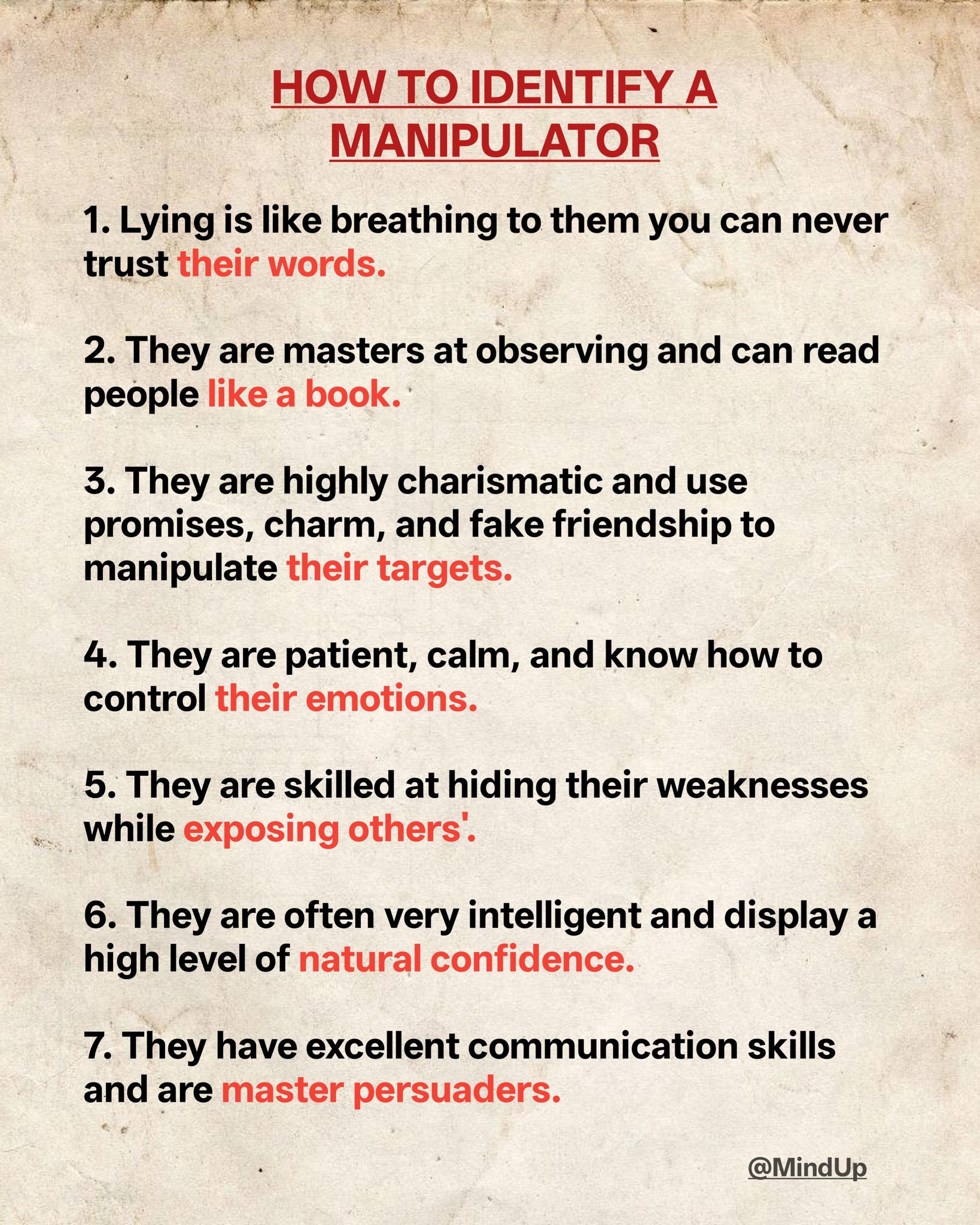
To effectively identify manipulative behavior as outlined in the provided infographic, one must cultivate skills in observation, critical analysis, and pattern recognition. These abilities develop through deliberate practice, such as maintaining detailed interaction journals, seeking feedback from trusted third parties, and studying established psychological frameworks on interpersonal dynamics (for instance, concepts from cognitive behavioral therapy or social psychology). Below, each characteristic is addressed with structured, evidence-based methods to enhance detection proficiency.
- Lying is like breathing to them; you can never trust their words. Develop this skill by systematically verifying statements against verifiable evidence. Maintain a chronological record of conversations, noting discrepancies in details, timelines, or facts upon repetition. Cross-reference claims with independent sources, such as documentation or corroborating accounts from others. Over time, repeated inconsistencies—particularly in low-stakes matters—reveal patterns without requiring confrontation.
- They are masters at observing and can read people like a book. To recognize this trait, observe the individual’s interactions across contexts: note whether they anticipate reactions, reference unshared personal details, or adjust their demeanor with uncanny precision to elicit specific responses. Practice by comparing their insights into your preferences or vulnerabilities against information you have explicitly provided. Training involves role-playing scenarios or reviewing recorded interactions to identify subtle cues, such as targeted questions that probe emotional weak points.
- They are highly charismatic and use promises, charm, and fake friendship to manipulate their targets. Identification improves through evaluation of relational reciprocity. Track the balance of give-and-take: excessive early flattery, unprompted promises, or rapid escalation to “friendship” without sustained actions often signals intent. Learn by documenting post-interaction feelings (e.g., obligation or idealization) and comparing timelines—manipulative charm typically fades once compliance is secured. Formal study of “love bombing” techniques via reputable psychology resources accelerates recognition.
- They are patient, calm, and know how to control their emotions. Spot this by monitoring emotional consistency under pressure. Manipulators maintain composure during conflict or delay gratification strategically, revealing control through measured responses rather than reactive outbursts. Develop detection by simulating mild stressors in neutral settings (or reviewing past incidents) and noting disproportionate patience that serves their agenda. Mindfulness exercises focused on your own emotional baselines aid in contrasting genuine calm with calculated restraint.
- They are skilled at hiding their weaknesses while exposing others’. Cultivate awareness by cataloging self-disclosure patterns: genuine individuals share vulnerabilities proportionally, whereas manipulators deflect scrutiny while highlighting others’ flaws. Practice active listening to identify deflection tactics (e.g., shifting topics to your shortcomings) and maintain private inventories of their admitted limitations versus observed contradictions. Peer consultation in professional or therapeutic settings refines this comparative analysis.
- They are often very intelligent and display a high level of natural confidence. Differentiate authentic intelligence and confidence from performative versions by testing depth: pose open-ended, scenario-based questions requiring substantive reasoning. True manipulators may pivot elegantly but falter on follow-up scrutiny or evidence-based challenges. Build proficiency through deliberate exposure to high-confidence individuals in controlled environments (e.g., debates or case studies) and journaling whether confidence correlates with accountability or evasion.
- They have excellent communication skills and are master persuaders. Enhance detection by dissecting persuasive techniques for logical fallacies, emotional appeals, or selective framing. Record key dialogues and analyze them for pressure tactics, such as urgency without justification or reframing objections as personal failings. Formal training—via workshops on rhetoric or critical thinking—combined with post-interaction debriefs (asking, “Did this exchange serve mutual interests?”) sharpens discernment. Over repeated exposures, persuasive mastery without corresponding integrity becomes evident.
Consistent application of these methods, ideally supplemented by professional guidance such as therapy or communication skills training, fosters reliable intuition. Early detection protects personal boundaries while promoting healthier interactions. If specific examples or further resources are required, additional details may be provided for tailored refinement.